Showing posts with label occult. Show all posts

The Kybalion: A Study of The Hermetic Philosophy of Ancient Egypt and Greece Review

The Kybalion: A Study of The Hermetic Philosophy of Ancient Egypt and Greece
Average Reviews:

(More customer reviews)
I don't care if The Kybalion was authored by William Walker Atkinson, either alone or with others OR it was Harriet Case (Paul Foster Case's wife at the time), Ann Davies (who succeeded Paul Foster Case as head of the B.O.T.A.), Mabel Collins (a prominent Theosophical writer), Claude Bragdon (an architect, Theosophist, and writer on "mystic geometry"), and Claude Alexander (a well-known stage magician, mentalist, proponent of crystal gazing. This is a great book in content and in style of writing.

Click Here to see more reviews about: The Kybalion: A Study of The Hermetic Philosophy of Ancient Egypt and Greece

This little book will tell you all you ever wanted to know about the "Ancient Wisdom". It is rather easy reading for a receptive and open mind.

Buy Now

Click here for more information about The Kybalion: A Study of The Hermetic Philosophy of Ancient Egypt and Greece

Read More...

The Watkins Dictionary of Magic: Over 3,000 Entries on the World of Magical Formulas, Secret Symbols and the Occult Review

The Watkins Dictionary of Magic: Over 3,000 Entries on the World of Magical Formulas, Secret Symbols and the Occult
Average Reviews:

(More customer reviews)
Now this is a very nice dictionary of the Occult. I like it a lot. Just what every good witch will need to help them with their learning. I highly recommend this. Real truth, no lies.

Click Here to see more reviews about: The Watkins Dictionary of Magic: Over 3,000 Entries on the World of Magical Formulas, Secret Symbols and the Occult

This second volume in the popular Watkins Dictionary series is filled with fascinating explanations for all things magical, from spells and secret rituals to mythical creatures. More than just handy reference, the many definitions and articles here—including pieces on Kabbalah, Tarot, and Gnosticism—provide a great introduction for neophyte occultists interested in expanding their understanding. But even seasoned readers will benefit from access to quick facts and interesting information, and enjoy dipping into the many biographies of occult figures (both well-known and obscure) as well as myths and folklore from around the world.

Buy NowGet 27% OFF

Click here for more information about The Watkins Dictionary of Magic: Over 3,000 Entries on the World of Magical Formulas, Secret Symbols and the Occult

Read More...

Freemasonry: Rituals, Symbols & History of the Secret Society Review

Freemasonry: Rituals, Symbols and History of the Secret Society
Average Reviews:

(More customer reviews)

The Freemasons are the largest fraternal organization in the world, and one of the most well known mystery societies. Author Mark Stavish is an active Freemason, a Thirty-Second degree member of the Scottish Rite, a member of the Knights Templar and the Order of the Eastern Star. Why is this important? Only someone on the inside, someone familiar with the workings of the Freemasons, could provide such cohesive insight into their history, their philosophy, and how their ideals interact with day-to-day life.
The depth of scholarship in this book is reflected, in part, in the acknowledgments section when Stavish speaks of the assistance given to him by Brother Charles S. Canning, Director of the Harry C. Trexler Masonic Library (Allentown, PA). Brother Canning not only performed research for this book, but he also reviewed the manuscript.
In his foreword, Brother Lon Milo DuQuette speaks of an informal gathering of Freemasons at an undisclosed location, in an incredibly beautiful Masonic Temple. Part of his reflection is on the building itself, and its incredible sense of geometry (something that Masonic Temples are known for). DuQuette indicates that Masonry is once again becoming a secret society, largely because of public concerns over its esoteric nature. He goes on to say that the only demographic group applying for Masonic membership in significant numbers is that of young men passionately interested in the esoteric mysteries of the Craft.
In his introduction, Stavish notes that the symbols used by Freemasonry have their roots in both Jewish and Christian religious and mystical practices, with the fundamental notion of Freemasonry being that of build or creating. Masonry has a great deal to do with how a man lives his life - with the virtues of faith, hope and charity, as well as the Golden Rule being implicit in all Masons. Stavish states that by the example of improving himself, a Mason improves the world around him. A Mason will also be religiously devoted/mystically inclined. Within himself, each Mason constructs the Temple of Wisdom. The mystical nature of a Mason comes last, according to Stavish, because it is most personal.
In the beginning of this book is a short chapter on how to use it. This impressed me, because it placed the reader on notice that this was not just a book to be read, information assimilated, and book set aside. The information presented here is a beginning, and there is a path to be followed. In "Freemasonry", Stavish presents the events that are behind the origin and growth of Freemasonry, why they are still important today, and how to live a "Masonic" life as a "creator, builder and friend of God and humanity", whether the reader wishes to wear a Masonic apron or not.
It is suggested that the reader have a notebook handy, along with colored pencils or pens. It is suggested that the reader go over the list of recommended books at the end of each chapter, and read one of them. Another suggestion is to pay attention to your dreams - Bravo Mr. Stavish - excellent suggestion! Another suggestion that I heartily concur with is starting each reading session with a prayer.
Covered in this book are the different types of Freemasonry, he history behind the Temple of Solomon, Masonic initiation, sacred geometry, the Masonic Quest, Scottish Rite, Occult Masonry, the York Rite and the Knights Templar, and Freemasonry and the European Occult Revival. Each chapter ends with a listing of Key Points, Assignments - actions that the reader can take, and a suggested reading list.
The appendices include "Sacred Geometry and the Masonic Tradition", by John Michael Greer, Symbols of the Tracing Boards and the Degrees, and Excerpts From "Morals and Dogma" on the Three Degrees of Masonry.
For anyone interested in knowing more about Freemasonry, or perhaps in joining the society, this book is an excellent first step on the path of wisdom.

Click Here to see more reviews about: Freemasonry: Rituals, Symbols & History of the Secret Society


As one of the world's most famous mysterious societies, Freemasons remain the largest fraternal organization in the world. Some of the most heroic and creative thinkers in history belonged to the order, including George Washington, Benjamin Franklin, Goethe, and Mozart. What links the philosophy of these great minds with the estimated four million Freemasons who actively maintain this ancient brotherhood today?

From sacred geometry to legendary Masonic rites, author and Freemason Mark Stavish divulges the philosophy of Masonry and the moral code that all Masons share. Learn how Masonry's higher degrees, particularly Scottish Rite, were influenced by occult beliefs and practices, and how Masonry is linked to King Solomon, Gothic architecture, magic practice, alchemy, and Qabala. With exercises and suggested readings, this fascinating exploration is an essential learning tool that will answer questions and shed light on other Masonic mysteries, including initiation and the Lost Word.

This is a Print-on-Demand title.Please allow an additional 2-3 days for delivery.


Buy NowGet 29% OFF

Click here for more information about Freemasonry: Rituals, Symbols & History of the Secret Society

Read More...

The Temple Legend : Freemasonry and Related Occult Movements Review

The Temple Legend : Freemasonry and Related Occult Movements
Average Reviews:

(More customer reviews)
In this book, Steiner writes:
"One cannot attain to what is usually known as immortality unless one is to some extent familiar with the occult sciences. The fruits of occult science do, of course, find their way out into the world along many different channels. A great deal of occult knowledge exists in the various religions, and all those who participate deeply and sincerely in the life of a religious community have some share in this knowledge and are preparing themselves for the attainment of immortality in the real sense. But to subsist on the knowledge of this immortality and the feeling of belonging in the spiritual world in concrete experience and with full awareness is still something different.

"All of you have lived many times but not all of you are conscious that you have lived through these many lives. However, you will gradually attain this consciousness, and without it man's life is lived with incomplete consciousness. It has never been the aim of occult science to inculcate into man a dim feeling of survival, but to impart a clear, fully conscious knowledge of onflowing life in the spiritual world. And there is a certain great law which governs the progressive development of consciousness in all future stages of life. Namely, it is what man works at to help others attain such consciousness which contributes the most to its development. It is an apparently paradoxical proposition: everything a being works at without aiming at developing its own consciousness helps to maintain that being's consciousness.

"It is a fact that all occult science consists of knowing how a man can act selflessly in order to attain the greatest enhancement of his own consciousness...For selfless deeds are the real foundation of immortality. "

Click Here to see more reviews about: The Temple Legend : Freemasonry and Related Occult Movements


Buy Now

Click here for more information about The Temple Legend : Freemasonry and Related Occult Movements

Read More...

Seth, God of Confusion: A Study of His Role in Egyptian Mythology and Religion (Ancient Near East) Review

Seth, God of Confusion: A Study of His Role in Egyptian Mythology and Religion (Ancient Near East)
Average Reviews:

(More customer reviews)
Overall, the author provides an excellent profile of the god Seth (or Set) and His place in the Egyptian pantheon. Discussed in detail is the symbology contained in the story of Seth's conflict with Horus, including Seth's homosexual rape of the child Horus, Seth's relationship to Isis, Osiris, and Nepthys, and His special position as a god of foreigners. In this latter area, Seth's relation to, and possible derivation from imported Semetic deities is covered thoroughly.
A main theme of this monograph is Seth's shifting place in the Egyptian pantheon of deities. Throughout ancient Egypt's long history, Seth was alternatively honored and despised, depending on the changing dominance of different religious, political, and social currents. Eventually, as Egypt came increasingly under the domination of foreigners, Seth, the god associated with foreigners and foreign things, became thoroughly demonized in the popular mind, and may well have been the prototype for the Christian Satan.
My only real criticism of this study, and this is only personal, is the highly specialized academic tone of the writing, along with the frequent inclusion of long untranslated quotations from German and French authors. The monograph is obviously written for the specialist in Egyptology rather than for the general reader. The untranslated quotations will, of course, pose no difficulty for readers who are fluent in both German and French.
I give the book a four star rating, only denying the fifth star for the reason metioned in the above paragraph.

Click Here to see more reviews about: Seth, God of Confusion: A Study of His Role in Egyptian Mythology and Religion (Ancient Near East)


Buy Now

Click here for more information about Seth, God of Confusion: A Study of His Role in Egyptian Mythology and Religion (Ancient Near East)

Read More...

Beyond the Flower of Life: Multidimensional Activation of your Higher Self, the Inner Guru (Advanced MerKaBa Teachings, Sacred Geometry & the Opening of your Heart) Review

Beyond the Flower of Life: Multidimensional Activation of your Higher Self, the Inner Guru (Advanced MerKaBa Teachings, Sacred Geometry and the Opening of your Heart)
Average Reviews:

(More customer reviews)
Although I agree with most of these reviews, I found that in Beyond the Flower of Life, Maureen does not assume that the reader is familiar with the Flower of Life, has taken a Flower of Life Workshop or even knows the MerKaBa meditation. Rather, she provides valuable information for anyone seeking their Higher Self to immediately apply, regardless of their background of spiritual study. Sure, there are MerKaBa specific details in the book (MerKaBa programs, questions answered, etc.), yet so much of the book contains useful, never-before-explained spiritual material that is fresh and current, that absolutely anyone can pick up this book and be enriched and intrigued by it.


Click Here to see more reviews about: Beyond the Flower of Life: Multidimensional Activation of your Higher Self, the Inner Guru (Advanced MerKaBa Teachings, Sacred Geometry & the Opening of your Heart)

Beyond the Flower of Life is a new Advanced MerKaBa book by Maureen J. St. Germain. If you are looking to enhance the MerKaBa practice or are ready to take it to the next level, this book was written with you in mind. Already practicing the MerKaBa Meditation and want to make it more fulfilling? Maureen St. Germain will give you MerKaBa insights to enhance what you already have. If you are looking for more heart centered awareness and understanding to fulfill your mind's longing, these tools help satisfy your mind, so it willingly quiets. If Higher Self contact is what you are looking for, Maureen offers a practical, achievable roadmap to manifest a 100% accurate relationship with your Higher Self. By teaching the MerKaBa to over 10,000 students worldwide and developing an Advanced Flower of Life workshop to accompany this work, Maureen has developed tools, techniques and knowledge to support your MerKaBa practice.
Beyond the Flower of Life will bring you peace, contentment and mastery. Along with MerKaBa insights, Beyond the Flower of Life offers the new information regarding the opening of the heart, the Christ Consciousness Grid, how to achieve Fifth Dimensional Awareness and going beyond Fifth Dimension. Since there is no higher energy than Love, Maureen believes it should be easy and effortless to marry the ego to the Higher Self producing Heaven on Earth. With almost 15 years as a Flower of Life course instructor and the outstanding success of her CDs, workshops and Sacred Journeys, she has more than proven this to be true. This unique book consists of steps to developing an accurate understanding of the MerKaBa Meditation and its capabilities - while strengthening your heart connection and learning to program your MerKaBa.
Since 1995, Maureen has developed these revolutionary techniques that allow one to gain full reliable access to their Higher Self. With these tools, MerKaBa Meditators will be able to achieve and exceed their understanding of the world around them and keep their heart open all the time. You may conclude that Maureen's Beyond the Flower of Life is the long awaited follow-up to Drunvalo Melchizedek's books, The Ancient Secret of the Flower of Life, Vols. I & II.

Buy Now

Click here for more information about Beyond the Flower of Life: Multidimensional Activation of your Higher Self, the Inner Guru (Advanced MerKaBa Teachings, Sacred Geometry & the Opening of your Heart)

Read More...

Secrets of the Lost Symbol: The Unauthorized Guide to Secret Societies, Hidden Symbols & Mysticism Review

Secrets of the Lost Symbol: The Unauthorized Guide to Secret Societies, Hidden Symbols and Mysticism
Average Reviews:

(More customer reviews)
This new book of Lost symbols, is extremly informative.. I was truly suprised of how much a wealth of knowlegde was contained in this book... very good read...

Click Here to see more reviews about: Secrets of the Lost Symbol: The Unauthorized Guide to Secret Societies, Hidden Symbols & Mysticism


Secrets of the Lost Symbol is an essential resource for Dan Brown fans who want to know the facts behind the fiction.

From Abramelin the Mage to the Zohar, this encyclopedic unofficial companion guide to The Lost Symbol uncovers the forgotten histories of arcane traditions that have shaped—and still inhabit—our modern world.

Discover the truth about Freemasonry—a major theme in Brown's best-selling novel—including its rituals, temples, and infamous members such as the legendary Albert Pike. Get the real story behind the Rosicrucians, the Temple of Solomon, and ancient occult rites.


Buy Now

Click here for more information about Secrets of the Lost Symbol: The Unauthorized Guide to Secret Societies, Hidden Symbols & Mysticism

Read More...

The Secret History of Hermes Trismegistus: Hermeticism from Ancient to Modern Times Review

The Secret History of Hermes Trismegistus: Hermeticism from Ancient to Modern Times
Average Reviews:

(More customer reviews)
While the traditional discussion of the Corpus Hermeticum begins with Marsilio Ficino's 1471 translation for Cosimo de' Medici, the discussion soon stalls with the centuries' old debate of the text and if the ideas it expresses are truly Egyptian wisdom or are merely a Hellenistic patch-work infused with Egyptian atmosphere.
In The Secret History of Hermes Trismegistus: Hermeticism from Ancient to Modern Times, Florian Ebeling takes a fresh approach by focusing on the character/author Hermes Trismegistus within countless literary sources attributed to him from Coptic, European and Arabic sources. Florian, beginning in Antiquity, isolates two distinct traditions and then follows them through the Middle Ages, the Renaissance and the enlightenment up to the twentieth Century, arguing that Hermes Trismegistus did not spontaneously appear in Italy during the Renaissance but was consistently popular, often referenced in both Europe and in the Middle East since his first appearance over 2000 years ago. Ebeling continues by outlining how Hermes as well as hermetic wisdom was eventually discredited then more recently vindicated by historic, religious and scientific opinion.
This new approach benefits from recent scriptural finds from Nag Hammadi, decipherment of Egyptian Hieroglyphics, and a greater, more critical understanding of the Hellenistic cultural milieu. By building on recent scholarly works like The Eternal Hermes by Antoine Faivre, The Egyptian Hermes by Garth Fowden and Hermetica by Brian P. Copenhaver, Florian Ebeling, breathes fresh life into the religious tradition of the Thrice Great Hermes allowing these ancient scriptures an increasingly wider audience.

Click Here to see more reviews about: The Secret History of Hermes Trismegistus: Hermeticism from Ancient to Modern Times

Perhaps Hermeticism has fascinated so many people precisely because it has made it possible to produce many analogies and relationships to various traditions: to Platonism in its many varieties, to Stoicism, to Gnostic ideas, and even to certain Aristotelian doctrines. The Gnostic, the esoteric, the Platonist, or the deist has each been able to find something familiar in the writings. One just had to have a penchant for remote antiquity, for the idea of a Golden Age, in order for Hermeticism, with its aura of an ancient Egyptian revelation, to have enjoyed such outstanding success."--from the IntroductionHermes Trismegistus, "thrice-great Hermes," emerged from the amalgamation of the wisdom gods Hermes and Thoth and is one of the most enigmatic figures of intellectual history. Since antiquity, the legendary "wise Egyptian" has been considered the creator of several mystical and magical writings on such topics as alchemy, astrology, medicine, and the transcendence of God. Philosophers of the Renaissance celebrated Hermes Trismegistus as the founder of philosophy, Freemasons called him their forefather, and Enlightenment thinkers championed religious tolerance in his name. To this day, Hermes Trismegistus is one of the central figures of the occult--his name is synonymous with the esoteric.In this scholarly yet accessible introduction to the history of Hermeticism and its mythical founder, Florian Ebeling provides a concise overview of the Corpus Hermeticum and other writings attributed to Hermes. He traces the impact of Christian and Muslim versions of the figure in medieval Europe, the power of Hermeticism and Paracelsian belief in Renaissance thought, the relationship to Pietism and to Freemasonry in early modern Europe, and the relationship to esotericism and semiotics in the modern world.

Buy NowGet 24% OFF

Click here for more information about The Secret History of Hermes Trismegistus: Hermeticism from Ancient to Modern Times

Read More...

The Ancient Egyptian Tarot, 2nd Edition Review

The Ancient Egyptian Tarot, 2nd Edition
Average Reviews:

(More customer reviews)
This is the deck I use when I need some guidance. This deck integrates the knowledge of Egyptian Mythology and solidly brings it into the present life circumstances. The author has brought the history of Egypt back to life.

Click Here to see more reviews about: The Ancient Egyptian Tarot, 2nd Edition

Barrett's accompanying book to his 78-card tarot deck gives seekers background information on each card, as well as how to use the cards for divination and to develop clairvoyant powers.

Buy Now

Click here for more information about The Ancient Egyptian Tarot, 2nd Edition

Read More...

The Secret Teachings of All Ages: An Encyclopedic Outline of Masonic, Hermetic, Qabbalistic and Rosicrucian Symbolical Philosophy Review

The Secret Teachings of All Ages: An Encyclopedic Outline of Masonic, Hermetic, Qabbalistic and Rosicrucian Symbolical Philosophy
Average Reviews:

(More customer reviews)
The over-riding theme of Manly P. Hall's book is that the most basic secret teaching is that one should overcome your animal, lower, inferior nature of lust, hatred, and greed and become more spiritual, realizing that this world is an illusion, which isn't your true home, and your body is not your true self. By following the golden rule instead of the rule of gold, one can become enlightened enough to avoid ever having to come back to this awful world again. Wisdom is to be valued more than gold. If you do not attain such spiritual wisdom, you are doomed to repeat your experiences by reincarnating or you may experience hell or purgatory, according to some faith traditions.
Hall criticizes modern times as being too materialistic. The more you focus on earthly desires, the more you become bound to it, the more misery you shall suffer here and after death. You should follow the urges of your higher self, the spirit and soul, which operate above you in the heavenly realms as your body stays upon on this earth while you learn your lessons.
But as far as lust goes, Hall does not recommend that everyone become celibate, since if you are not particularly enlightened it would not be appropriate for you and may lead to neurosis.
Hall goes over the symbolism of many esoteric traditions in this mostly interesting, but sometimes boring book. This is a big, long, thick book that is crammed with so much information it's hard to remember it all. A lot of the explanations of symbols gets tedious after awhile and I asked the question occasionally, "Why should this be important to me?" Especially dense was the sections on the Kabala symbolism. Hall also goes over Biblical symbolism as allegorical true, not literally true, and it is based on earlier pagan traditions.
I liked the sections on black magic versus white magic and the life of Doctor Faust, who Hall claims was a real person. Hall warns us never to get involved with black magic and make pacts with evil spirits for our own temporal and selfish gain since we will be doomed to serve the spirit for eternity once we break one of the conditions of the contract as Faust did. Such evil comes from selfishness, the source of all evil. Hall is even cautions us against hypnosis and calls high pressure salesmanship a form of black magic. He says that mediums that pretend to be speaking to dead loved ones are actually elemental spirits acting like dead loved ones. It is not good to dabble in black magic just out of curiosity. I was surprised he sounded so much like a fundamentalist preacher on this topic.
White magic, however, seems to be okay with him and he has a section in which one is shown how magic can be used by invoking Christ's name and giving him the glory, using it for the expansion of your wisdom, not the fulfillment of your selfish desires.
Hall gets into the question of who really wrote Shakespeare's plays. Shakespeare himself really did not have the educational background to be able write the plays that had so many erudite references. Hall shows us that Francis Bacon was the one who wrote the plays and the various ways that he gave clues that he actually did write them. Francis Bacon was also a freemason who had the knowledge of how to conceal information through cryptograms, which are contained in his writings.
The book covers a myriad of esoteric topics and persuades the reader to take seriously the phenomena of alchemy, the Delphic oracles, and the mysterious Saint Germaine, among other things. The freemasonic origins of the United States is covered some also.
Alchemy is the process of turning base metals into gold. Metaphysically, humans are also attempting over several lifetimes to eliminate their base natures and turn to the golden light of virtue. That is what alchemy allegorically represents. Hall gives of us some examples in history in which alchemy was said to have actually occurred.
The French and American Revolutions were inspired by the freemasons. This occult group wanted to get rid of the tyranny of monarchy, the ignorance of the general populace, and the superstitions of the church. By electing a philosophical elect, the people would be well served by their governments (in theory). The original seal of the US might actually be the occult symbol of the phoenix, instead of the eagle. The French Revolution was not as successful for the freemasons since a violent reign of terror ensued, perpetrated by fanatics.
Why is the occult kept hidden from the general populace? It is hidden because of the prejudice against certain occult teachings that people aren't ready to accept. The powerful status quo is also threatened by such teachings. There is the prohibition of against throwing your pearls before swine who will only abuse such teachings. One must be worthy to accept the mysteries, which means that you have to be moral enough to receive the teachings. Mystery schools often have initiates go through many trying ordeals before they are considered worthy enough to reach the next level of wisdom.
Some occultists have a reputation for being immoral though. Hall explains that occult schools are only as good as the people in control of them. Over the years, a once virtuous group can become corrupted. That is the reason why some occult groups are considered bad.


Click Here to see more reviews about: The Secret Teachings of All Ages: An Encyclopedic Outline of Masonic, Hermetic, Qabbalistic and Rosicrucian Symbolical Philosophy


Buy Now

Click here for more information about The Secret Teachings of All Ages: An Encyclopedic Outline of Masonic, Hermetic, Qabbalistic and Rosicrucian Symbolical Philosophy

Read More...

Freemasonry of the Ancient Egyptians Review

Freemasonry of the Ancient Egyptians
Average Reviews:

(More customer reviews)
This is a great book, but not an easy read. There is much here to be read several times and pondered upon.
The author states his purpose in writing the book is: "To suggest an interpretation of Egyptian metaphysical tradition in harmony with with the teachings set forth in what we call the mysteries."
In the introduction, the author lodges a valid criticism of some academics in the fields of Egyptology and archaeology. He makes a distinction between two types of academics. The first are those who are too close to the to see the trees. They are "materialistic minded men" bent on maintaining their reputations and place in the academic community. Terrified of controversy and change. Unwilling to accept conclusions and new theories based on the latest scientific methods. The second group are those bold enough to speculate on new ideas based to modern exploration and research. These people are unafraid to reveal their conclusions to public scrutiny.
This work will be of interest to hard-core students of Freemasonry, especially those who are open-minded and inclined to search for the roots of Freemasonry among the ancient Egyptians.
To the Master Mason interested in the origins of the Craft, the section dealing with the "Crata Repoa" will be quite interesting. To avoid forming the misconception that he is reading the narrative of a modern ritual The reader must keep in mind the author is dealing with a ritual that could only have originated in ancient Egypt and passed down through the ages. Ultimately, the reader must make up his own mind about the information presented by the author.
In chapter Four, "The Secret Doctrine of Egypt", Freemasons will be fascinated by the author's treatment of the "Widow's Son".
Those who are not members of the Masonic fraternity may have difficulty grasping some of the concepts relating to Freemasonry presented by the author.
Manly P. Hall was raised on November 22, 1954 in Jewel Lodge No. 374. In 1990 Mr Hall was elevated to the 33d degree, the highest honor and degree in Freemasonry.
The author has written other books on Freemasonry: "The Lost Keys of Freemasonry"; Masonic Orders of the Fraternity"; and "The Secret Destiny of America".
An extremely interesting section of the book presents the author's perspective concerning the "Curse of Tutankhamen's Tomb".
In my opinion, this book will not be well received by Christian Fundamentalists and the hierarchy of the Roman Catholic Church, based on the author'frank and historically correct criticism of these two groups.

Click Here to see more reviews about: Freemasonry of the Ancient Egyptians


Buy Now

Click here for more information about Freemasonry of the Ancient Egyptians

Read More...

The Egyptian Book of the Dead (Penguin Classics) Review

The Egyptian Book of the Dead (Penguin Classics)
Average Reviews:

(More customer reviews)
This edition of Budge's book of the Dead is not the same as the Dover edition (the Papyrus of Ani). It's in fact an edition Budge published a few years later (The Chapters of Coming Forth by Day), and it's a compilation of all the papyri available at the time, making this the most complete edition of the Book of the Dead available today. The translation itself has over 3 times the material in the earlier edition, and the translation is more polished than Budge's earlier work. If you have the Papyrus of Ani, I recommend you get this as well, as you're missing out on a ton of material. While the binding and presentation is not as good as the Dover, in terms of contents it is unbeatable.

Click Here to see more reviews about: The Egyptian Book of the Dead (Penguin Classics)

The most famous of all ancient Egyptian texts—with an introduction by one of the most celebrated Egyptologists of our timeAMONG THE MOST WIDELY read and studied of all ancient writings, The Egyptian Book of the Dead consists of funerary texts that ancient Egyptian scribes composed for the benefit of the dead. This astonishing array of spells, hymns and litanies, magical formulae and names, and words of power and prayers were all found cut or painted on walls of pyramids and tombs, and painted on coffins, sarcophagi, and rolls of papyri.

Buy NowGet 32% OFF

Click here for more information about The Egyptian Book of the Dead (Penguin Classics)

Read More...

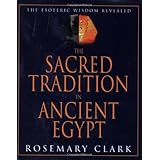
The Sacred Tradition in Ancient Egypt: The Esoteric Wisdom Revealed Review

The Sacred Tradition in Ancient Egypt: The Esoteric Wisdom Revealed
Average Reviews:

(More customer reviews)
Two hundred years ago, Egypt seized our interest in its great mysteries and the unbelievably long civilization they created when Champollion, the young French genius, discovered the key to translating the Rosetta Stone bearing inscriptions in Egyptian hieroglyphics, demotic characters (a simplified form of ancient Egyptian writing), and ancient Greek.
Egyptian texts present the translator with greater technical problems than most ancient tongues. The Egyptians left behind none of the usual and invaluable aids to translation. Like modern Hebrew and Arabic, Egyptian was written without vowels, so that only the consonantal structure is left. Its vital organs are gone, leaving behind dry bones. Much of the poetry and word play is lost forever. Much eludes us.
Merely translating the hieroglyphics was truly not enough, however, since the hieroglyphs are not only pictures (such as an owl), but also picture-signs used to convey the sound and meaning just as our alphabet does for us. An owl, for example, also stands for the letter "m," just in case you're curious. It does not end there, because there is also an inner meaning to the pictures, so that it was not so much the cat, dog, or snake that was worshipped, but the principle it represented; and that principle was, in turn, as aspect of the greater creation or ultimate spirit. Our modern quest for the wisdom of ancient Egypt centers on the true meaning of the symbolism, temples, tombs, and pyramids of this enigmatic motherland. We know many Egyptian words that express some degree of fear or happiness, but which one of these expresses dread, anxiety or worry? How do we distinguish between ecstasy, delight, joy, and jubilation?
Egyptologist Rosemary Clark, who reads Egyptian hieroglyphics firsthand, examines the esoteric tradition of Egypt in remarkable detail. She explores dimensions of the language, cosmology, and temple life to show that a sacred mandate--the transformation of the human condition into its original cosmic substance--formed the foundation of Egypt's endeavors and still has relevance today.
As founder of the Temple Harakhite, a group devoted to the experiential religious practices of Egypt's Old Kingdom. She is well versed in hieroglyphic script, its transliteration, and the translation of ancient texts, and in the subtleties of Hermetic philosophy and Sacred Science. I especially enjoyed the history of the initiatory schools and the Mystery Tradition recorded in ancient times and their methods of clairvoyance, prophecy and healing.
Clark quotes R. A. Schwaller de Lubicz from "Esotericism & Symbol." He said, "Initiation does not reside in any text whatsoever, but in the cultivation of intelligence of the heart. Then there is no longer anything occult or secret, because the intention of the enlightened, the prophets, and the "messengers from above" is never to conceal--quite the contrary."
This is the time of revelation of all occult secrets.

Click Here to see more reviews about: The Sacred Tradition in Ancient Egypt: The Esoteric Wisdom Revealed


Buy NowGet 34% OFF

Click here for more information about The Sacred Tradition in Ancient Egypt: The Esoteric Wisdom Revealed

Read More...

Sacred Magic Of Ancient Egypt: The Spiritual Practice Restored Review

Sacred Magic Of Ancient Egypt: The Spiritual Practice Restored
Average Reviews:

(More customer reviews)
THE
SACRED
MAGIC
OF
ANCIENT
EGYPT
Llewellyn Publications, 2003
BY
ROSEMARY CLARK
A REVIEW
H.H. Rev. Ptahmassu K.M. Nofra-Uaa
Nuhati Temple Fellowship
San Diego, California
www.thelivingnuhati.org
Once in a great while a new volume on the Temple Tradition of Ancient Egypt is released that not only sparks our interest, but demands our attention and holds onto it with tenacity. Rosemary Clark's book The Sacred Magic of Ancient Egypt: The Spiritual Practice Restored (Llewellyn Publications, 2003) is one such work- a work that should be considered mandatory reading for anyone who attempts to find meaning and a path of faith in the Wisdom Traditions of the Ancient Egyptians.
This is a large companion volume to the sizeable The Sacred Tradition in Ancient Egypt: The Esoteric Wisdom Revealed (Llewellyn Publications, 2000), a book that is highly recommended to readers before they attempt to apply what is presented in its sequel. For students of the works of renowned metaphysician-philosopher R.A. Schwaller De Lubicz (not forgetting those of his wife Isha Schwaller De Lubicz), Rosemary Clark's volumes will become indispensable research and study guides for the high science through which the Temples, monuments and theological works of the Ancient Egyptians were composed. Whereas the strictly scholarly works of R.A. Schwaller De Lubicz serve as a tool for mapping out what Egypt's Temples and tombs say to us on an intellectual (and some would say anthropological and / or philosophical) level, Rosemary Clark has given us a far less clinical, and much more practical method for approaching the beauty of the Egyptian Mystery Traditions preserved in the monolithic religious remains of Ancient Egypt.
From its beginnings, Sacred Magic asks us to open up the heart of devotion for the Force that truly made Kemet (Ancient Egypt) the forerunner of human civilizations. A Hymn to Harakhte immediately identifies for readers a book that strives to celebrate the Faith of Ancient Egypt, not merely dissect it through boring scholarship. Rosemary Clark, though bearing a gifted scholarly mind grounded in the "discoveries" of Egyptology, is clearly separated from academic Egyptology in her writings because she is not an outsider to the mystical tradition(s) she is trying to explain. It is apparent in the pages of this volume that Rosemary Clark is on the inside of the Ancient Egyptian Tradition, looking out through the eyes of a devoted scholar and teacher of the Sacred Science she helps us to investigate.
The first two chapters of Sacred Magic, "The Legacy of Ancient Egypt" and "Esoteric Architecture", dissect the crux of the ancient Temple and its environment, together with the ancient world view that gave birth to a highly complex system of cosmic investigation spanning more than 3,000 years of human history. Like the De Lubicz's before her, Rosemary Clark unfolds the Temple of Egypt as an Earthly replica of the Heavens and its solar, stellar and lunar harmonies. The Temple in Ancient Egypt was far from being a "church" or place of adoration for the masses. It was a machine in stone, whose minutest details in relief, writing and statuary functioned as a lens through which the Divine rhythms of Heaven were brought sharply into focus. In sections such as "The Worlds of Creation" and "The Powers of Creation", Mrs. Clark convinces us that such was the case throughout all of Pharaonic history, providing the reader with clear tables and diagrams mapping out the ancient realms of Creation as defined through Egypt's principal theological schools, and in the family systems of the Neteru- the "Gods and Goddesses" recognized by the Ancient Egyptians that truly embodied (and embody) the Cosmic Functions of Creation, the Universe and Nature combined.

What is at once so rewarding in Sacred Magic is its definition of the Neteru as more than just the focus of "cults" and "mythology", as is the rule of thumb in the sterile writings of Egyptology. In her significant contribution to the decipherment of the Ancient Egyptian Faith, Mrs. Clark brings out for us the true relationship of Egypt's Gods to Her people, and expresses to readers the Divine Science that eternally linked Kemet to its multitudes of Divinities. Throughout Sacred Magic, we have the opportunity to investigate the forms, functions and Rites (Khesu) of the Neteru as personal Gods and Goddesses, that is to say, as Saviors and Protectors that have tremendous power to transform devotees both psychologically and spiritually. This is accomplished with abundant responsibility as the author maps out for students and devotees a logical program for study, worship and ritual that includes complete liturgies in both Medu (hieroglyphics) and English.
In "Theurgy" and "Liturgy" this volume attains its chief objectives, which is to reestablish the great Temple Tradition(s) of Kemet in a contemporary environment, utilizing the Ancient Scriptures and ritual structures through programs that can be easily achieved in a group devotional setting today. Without lending herself to the New Age hokiness that most often accompanies the recreation of Ancient Egyptian ritual, the author gives us beautiful and traditional Rites paired with descriptive yet succinct instructions for carrying out the adoration of the Neteru. What becomes unarguably clear in reading these particular sections of Sacred Magic is that the Temple System(s) of Ancient Egypt is not only relevant to today's spiritual / religious practitioners, but essential to those of us who desire union with the Mystery Paths of the Neteru. Such a system as that promoted in Sacred Magic- that is, a system using Sacred Astrology, Theurgy and Liturgy as its basis for contacting and comprehending the Divine- forms the foundation for the reestablishment of the Ancient Temple of the Neteru today in a way that remains true to both individual and group dynamics. Although Mrs. Clark bestows the Temple setting with various ranks of Priests and Priestesses, she makes it painfully clear that there is no hierarchy necessary for the accomplishment of the Ancient Egyptian Temple Tradition in the present time. Each function of the Hem(t) Neter or Patron of the Divine House is regarded as essential to the overall function of the Temple, and each is a personal pathway leading ultimately to higher realization of the Temple goal, which is personal union with the Divine, Neter.
For those with a keen interest in the study of Sacred astronomy and astrology as it was perfected by the Ancient Egyptian Temple Tradition, the author's in depth treatment in "Cosmic Resonance" (Chapter Three) is a significant read. This is no light treatment of the subject of solar, stellar and lunar correlations and relationships, but a vast reservoir of dedicated research that deserves special attention for those who wish to pattern their Temple after the precise observations of the Ancient star-watchers and chroniclers. The solar and lunar calendars observed by the Ancients are fully detailed and brilliantly investigated, offering us important tables for carrying out lunar observances and / or Sacred Rites according to the phases of the moon and the Neteru Who manifest through each phase. Such a treatment can hardly disappoint, especially when the author has gone so far in her investigations as to explain the entire zodiac in its correlations with the various Families or Pantheons of the Neteru. Each sign and month in the zodiac is detailed with careful references to their corresponding Neteru, including scents, metals and other natural compliments. This insightful section leaves us with astrological "profiles" of sorts of the Neteru Whom Mrs. Clark asserts can be matched to each of the zodiacal signs. The result is a treatment of Temple Astrology and Astronomy that provokes greater awareness, and satisfies the student of the Heavens graciously.
"Ceremony" and "Transformation" (Chapters Six and Seven) offer one of the most significant contributions to the Temple Tradition(s) of Ancient Egypt I have read in recent years. This is where the author's narrative skill and meticulous research shine through with precise clarity and sensitivity, offering Temple practitioners today an illumination of the function of Rites to the Neteru and the Heka or "Power", "Magic" They embody as manifestations of Heaven on Earth. Rosemary Clark presents her readers with observations grounded in several Ancient Texts and observances, including the Hebu, the Book of Breathings, the Festival of the Joyous Union, the Invocation of Khons, the Book of Hours, and the Lamentations. Each Sacred Observance is carefully illuminated by Ancient inscriptions and thorough tables of comparative information, making an inexhaustible reference for any Servant of the Neteru, Whose aim is to consecrate a proper Temple to Neter that can function according to the multidimensional goals of several participants. Each prayer is accompanied by the appropriate Medu, with English to clarify, and translated from the original texts with obvious dexterity. In reading these sections of Sacred Magic it is more than obvious that Mrs. Clark is herself a dedicated Master and practitioner of the Ancient Egyptian Temple Tradition, and a devoted scholar of the Neteru who wishes to grant others the transformative experiences that such a great tradition has to offer the world of spiritual aspirants.
Much more could be said about Sacred Magic's contents, however, I sincerely feel that the volume speaks for itself, and beautifully so, from the first page to the last. A review of any length could hardly hope to capture the scope and depth of Rosemary Clark's intensely dedicated scholarship and research, so I will simply conclude by asking my readers to investigate this book, and diligently apply it to the uses for which it was intended. Mrs. Clark has effectively summed up the contents of both her tremendous volumes in a single, simple sentence: "...a sacred tradition must be lived to realize the benefit and vital power it possesses". I couldn't have said it better myself.

Click Here to see more reviews about: Sacred Magic Of Ancient Egypt: The Spiritual Practice Restored


Buy NowGet 27% OFF

Click here for more information about Sacred Magic Of Ancient Egypt: The Spiritual Practice Restored

Read More...